

Leica Noctilux 50mm F0.95 Long-Term Review
A definitive look at a legendary lens

Introduced nearly 20 years ago, the Noctilux 50mm F0.95 continues to attract and inspire dialogue within a growing Leica community. Where some lenses rise and fall in popularity, this 50mm holds a coveted position as the ultimate light gatherer. But let me be honest: for the first few months, I hated it.

There was something about this lens—this friction I’d never experienced with any of my other Leica glass—where I couldn’t translate its features into images that had substance. Images that weren’t just shouting, “Hey! Look at all this bokeh!”
It would take me the better part of a year, wielding this beast around the world, before I understood exactly how to use this brush to create great results.
Look, this isn’t just a review. Think of this also as post-game analysis from a year-long season that’s not only going to discuss the strengths and weaknesses, but a clear process on **how** to use this prolific glass. And importantly, a clear explanation on who should invest in a lens like this.
Upcoming Events & Workshops
Leica Connect: Photo Stories from Around the World - Seattle
I’ll be joining a free event at Leica Store Bellevue for an evening of stories from my recent photography adventures with my SL kit. If you’re in the greater Seattle area, come by and let’s connect.
Leica Akademie: Video for Photographers - London
This June, I’m leading a two-day workshop in London for photographers who want to learn video. Whether you’re looking to create short films, branded content, or simply elevate your visual storytelling, this workshop provides a practical introduction to filmmaking. Sign up here.
Seats for my 2026 India workshop are currently sold out. If you’re still interested, you can join the waitlist here to be notified if a spot opens up or when new dates become available.
Why Is This Lens So Special? The Short Answer
The strength of a 50mm lens lies in its ability to isolate a subject for an honest dialogue between the viewer and the image. In the hands of a beginner, this is a perspective that can feel sterile and boring, but give it to an artist, and you’ll witness a master editor that knows how to carve a story. This Noctilux 50mm F0.95 is like giving that same artist 10,000 cc of adrenaline specifically designed to exaggerate the depth around that story.
If a standard 50mm shows awareness, this lens is about hyper-focus.

The combination of extremely high-quality glass, precision manufacturing techniques, and an aperture wider than most know what to do with all contribute to extreme subject isolation. The Noctilux doesn’t just blur backgrounds. It Thanos-snaps them into a painterly memory. This effect creates a “pop” that propels the distance between your subject and the world behind them.
Now, this could all feel like a cheap trick or an unpredictable mess if it weren’t for the aspherical elements. A lot of brands will throw this term around, but with Leica, you can expect a level of predictable sharpness that delivers where it counts without feeling like crispy fried chicken. The story begins with a clear point of focus and then takes an intentionally steep fall-off into an ocean of tonality.
This 50mm Noctilux is an unapologetic, heavy, and occasionally frustrating masterpiece. It isn’t a lens for the inexperienced, the impatient, or the weak of wrist. It’s the ultimate subject isolator. You just need to learn **how** to use it.
How Can You Get The Best Results?
I’ll admit something: I was ready to sell this lens almost immediately after I got it.
The Noctilux was supposed to be a unique brush in my kit, but after the first few weeks, I couldn’t find the value. I devoured every review and studied every article, but no one could actually explain how best to use the thing. There was no shortage of sample photos, a few were decent, but most were entirely forgettable. The photographic equivalent of a participation trophy.
Thankfully, a couple of friends urged me to give it more time. They told me to take the lens abroad and just put in the hours. It would take me three months of wrestling with it before it finally clicked.

The Leica Noctilux 50mm F0.95 is a lens that starts with the background, not your subject. We already know the aperture, elements, and coatings are going to make your subject jump off the frame so what you actually need to pay attention to is where that subject is leaping from. You have to imagine you’re painting with the out-of-focus area.
Like a 19th-century Impressionist, finding success here lies in studying the elements behind your subject, imagining them as brush strokes, and orienting them to elevate whatever this 50mm is isolating. Once that clicked, I knew the lens was never leaving my collection.
Again: start with the background, then compose your story.
Once I had the philosophy down, I wanted to refine the mechanics to ensure I was getting consistent results. For starters, you have to babysit your highlights. At this aperture, you’re always one stop away from losing information to the void. Next, I’d start at the minimum focus distance—which is one metre or just beyond arm’s reach—to frame the subject within that curated background. I’d then aim for a point of high contrast, like where the pupil meets the sclera, and fire a few frames while gently rocking in and out.

With practice, it all comes together for a reliable process. This is training. This is going to the gym. The only reason you put yourself through it is so you’re prepared for the moment that matters. When I finally invested the time to understand what this brush could do, I stopped fighting the lens and started excelling with it.
One more thing: this is a lens you do not stop down.
Legend has it that the original design didn’t even have an aperture ring. It was intended to be a constant 0.95. While they eventually abandoned that idea for the “greater good” (and perhaps to appease the faint of heart), I still believe stopping this lens down is blasphemy. If you want more depth of field, use another lens. When there’s a Noctilux mounted on your camera, it’s there to maximize light and depth. At least, in my humble opinion.
What Is The Image Quality Like?
The Noctilux name isn’t synonymous with optical perfection. It’s a visual flavour profile that strives for a specific look that complements human subject isolation. What do I mean by that? Well, for starters, the sharpness on this lens is about as sharp as you’d ever want it toward the centre. Toward the edges, there’s a softening and a slight vignette that contributes to the overall look of this lens.

What enhances the look is the contrast. You get a generous amount across the plane of focus, which contributes to a more modern rendering, and even packs a little more punch on newer Leica sensors. But because of the steep fall-off in sharpness and contrast from the plane of focus to the out-of-focus area—what some refer to as the “Focal Gradient”—there’s this juxtaposition that forces the viewer’s eye into a singular, undeniable truth while the rest of the world politely dissolves into an abstract memory.

When you’re shooting into backlit environments and have a lot of high-contrast edges in the frame, at F0.95 you’re going to invite some noticeable chromatic aberration and colour fringing. I can’t say this is a flaw as much as it’s a blind spot. You see, I feel like Leica could’ve corrected for this, but then it might risk changing that signature flavour profile. So you have this gap you have to consider when you’re shooting.
I won’t go into the weaknesses of this lens just yet. But with respect to aberrations relative to image quality, there are specific environments where this can conflict with your image. Like I alluded to earlier, if you’re paying attention to your background, this may end up being a non-issue in your work. And that’s a great place to wrap up this section on image quality.

The out-of-focus rendering here isn’t just a blurred background. It’s this deliberate, oceanic weight that anchors the entire frame. While lesser lenses might produce a nervous or “jittery” bokeh that competes for attention, the Noctilux delivers a wash of tonality that feels thick and intentional, like wet oil paint spread across a canvas. It’s a rendering that doesn’t just fall away, it cradles the subject, turning the clutter of a street or a messy interior into a soft, glowing sea of shapes that serves the subject rather than distracting from it.
How Is This Lens Built?
To substantiate the asking price of a lens like this, the conversation starts with image quality but importantly, it ends with how it’s made. You have to look into the physics of what’s essentially a hand-built light-seeking missile. While cheaper alternatives brute-force their way to F0.95 with generic glass and modest design, Leica treats the construction of this lens as a high-stakes engineering exercise.

First, this Noctilux uses an eight-element design, five of which are forged from glass with anomalous partial dispersion. Think of these as optics designed to hunt down and kill excessive colour fringing before it hits your sensor. Three other elements feature extremely high refractive power, allowing Leica to keep the lens relatively compact—about 75mm long—while still gathering an absurd amount of light.
The real flex, however, is the two aspherical surfaces. Unlike mass-produced optics that use “pressed” aspheres, these are meticulously ground and polished to tolerances that would make a watchmaker sweat. This is the reason you get that predictable sharpness in the centre rather than a hazy, “dreamy” mess.
The focus mechanism feels like a blade gliding through warm butter, and it’s because of a floating element system where the rearmost lens group moves independently to the rest of the assembly. This ensures that when you’re shooting at a one-metre minimum focus distance, the image quality doesn’t suffer.
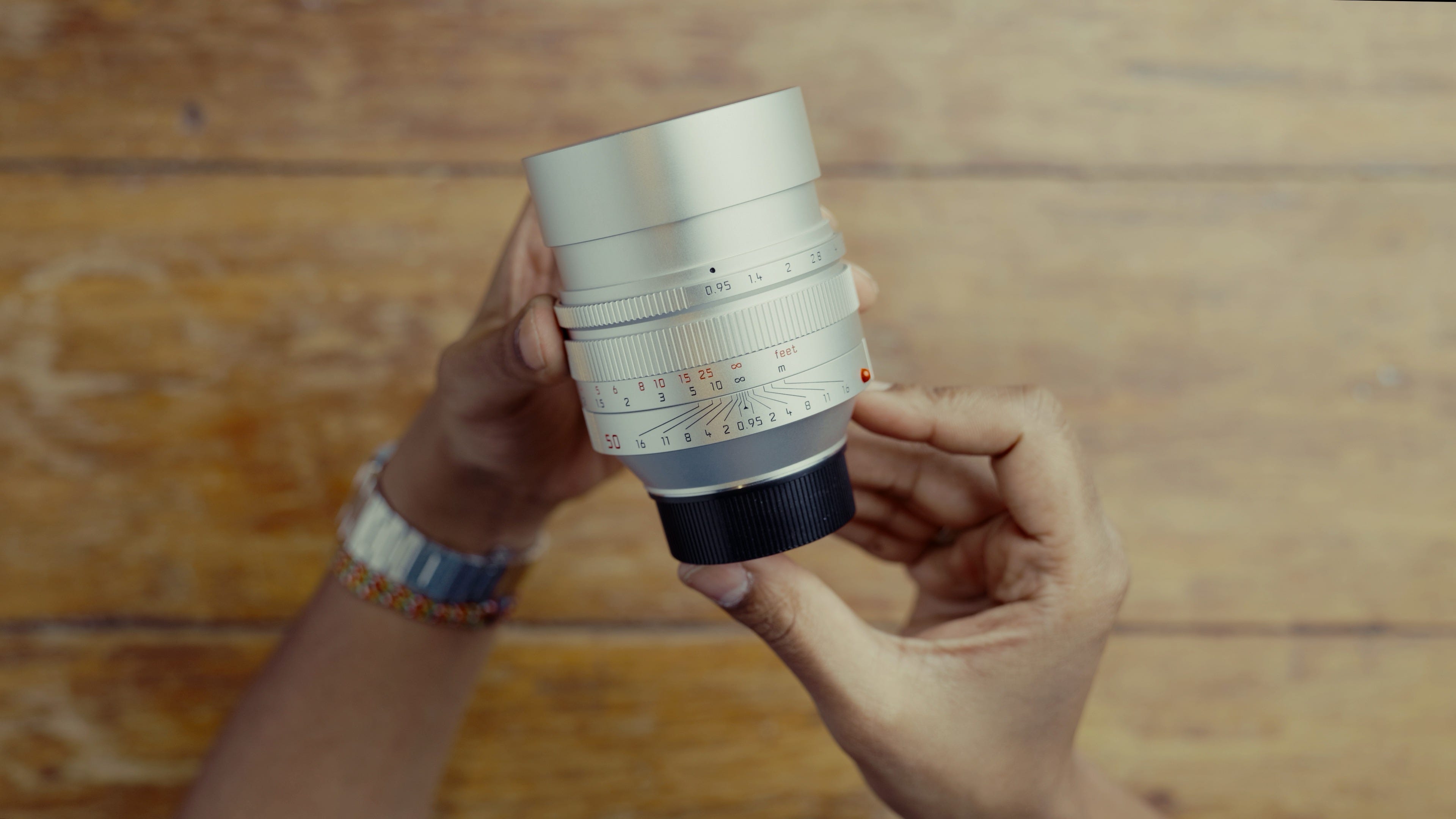
The body itself is a dense 700g cylinder of brass and aluminum, featuring a built-in lens hood that locks with a twist. There’s a 60mm front diameter designed to funnel as much light as possible into an 11-bladed diaphragm. This isn’t the most common filter size, but it’s still relatively easy to shop for when it comes to ND filters. And yes, you’re going to want to buy an ND filter.
All in all, this is an extremely high-quality product designed to deliver a specific experience. When you hold this Noctilux and interact with it, you immediately see how it differs from cheaper alternatives. It’s the difference between a mass-market tool and a bespoke instrument.
Where are the challenges of this lens?
Every lens is a collection of compromises, but with the Noctilux, those trade-offs can feel as heavy as the glass itself. At a beefy 700g, the handling is undeniably front-heavy, often feeling like the lens is wearing the camera rather than the other way around. Interestingly, this ergonomic tension disappears when you mount it on an SL body. The added grip and mass of this system balance the Noctilux perfectly.
On an M, however, the physical breadth introduces a literal blind spot. Because of the large diameter, the lens barrel obstructs the lower right portion of your frame lines. While you eventually learn to sort of “see through” the metal, it’s a constant reminder that you’re shooting with a big boy and not a street-friendly Summicron.
Then there are some mechanical quirks. The aperture ring on this lens can feel a little too jittery. It’s too easy to accidentally knock it off F0.95 while you’re pulling focus. It’s a loose experience that requires a bit of babysitting.
Speaking of focus, the one-metre minimum distance often left me wanting more. In a world where modern M lenses are pushing into 0.4m territory, beyond an arm’s length can feel like a barrier when you’re trying to get intimate with a story.
Finally, we have to talk about the chromatic aberration and colour fringing again. In certain circles, this has become an exaggerated talking point—a “gotcha” for those who prefer spec sheets over actual shooting. Yes, you’ll see purple fringing in high-contrast transitions if you aren’t careful. But usually, this is the hallmark of an inexperienced shooter who hasn’t learned to manage their highlights or consider their background. That said, it’s a gap in the armour worth tackling in an updated version. I think we’d all love to see Leica mitigate this provided they can do so without sanitizing the visual flavour that makes this lens a Noctilux.
Who Should Own This Lens?
The advent of extremely affordable Noctilux alternatives has caused some people to question whether this lens is worth it, and I have to say, this is an incredibly silly thing to ask. What’s far more valuable is asking **how** this Noctilux can elevate and enhance the stories you hope to share.
It goes without saying, but I’ll say it anyway: a Noctilux is not for most people. While a crowd of affluent enthusiasts will throw their coins for some cheap bokeh tricks, this is a lens that best serves a photographer who understands the strengths of a 50mm lens and is prepared to approach photography more like painting.

When you can draw inspiration from the art world of the late 1800s and can channel that in the moment to identify rich backgrounds that can serve a meaningful subject, you’ll find an incredible amount of value in a lens like this. And when you invest the time in your post-production workflow, well, you’re really at an advantage to create striking moments that deserve to be printed.
Owning this lens isn’t a status symbol, even though some fall into that trap. If you’re asking me, it’s a commitment to a specific, high-stakes approach to seeing the world. It’s for the relentless artist who’s willing to hit the gym, study their scene, and wrestle with a beefy light-cannon. While the world moves toward the clinical perfection of computer-calculated optics, the Noctilux remains a defiant, hand-built middle finger to the market that demands you to slow down and actually think about the brush strokes behind your subject.
If you’re prepared to put in the reps and develop a process, this lens won’t just sit in your collection. It’ll redefine the boundaries of what you thought a 50mm perspective could achieve.
Previous Favourites
March Contest
This month, I’ll be giving away a $200 gift card to the Moment Shop where the winner can save big on their next camera, lens, bag, or courses. Moment has so many creative products to choose from and $200 can absolutely make for a great deal.
How will I pick the winner? Make sure you’re signed up for this newsletter then leave a comment on at least one post from this month. I’ll be randomly picking one person, confirming they meet the requirements and contacting them directly before announcing the winner publicly.
As always, this contest is void where prohibited by law. Good luck!
My thanks to the team at Moment! Not only for this contest but for being the longest supporter of my work online. They’re a lean team of passionate creators that truly believe in supporting other creatives on their journey. Whether it’s a new camera, lens, workshop, or just some great articles, visit ShopMoment.com today.
What’s Next?
My time in Patagonia is coming to a close and it’s been far more fulfilling than I ever could’ve expected. I find myself still grasping for the words to contextualize this experience, both for myself and for you. Rest assured, I’ll find those words soon. There’s a few long flights ahead of me. Plenty of time to put thoughts into stories.
GB
"I was ready to sell this lens almost immediately after I got it." I remember and am so glad you didn't!
"I feel like Leica could’ve corrected for this" They couldn't when this was in development, starting over 20 years ago now, but they can now. Look at the 35MM f1/2 Noctilux as a guide on technology, size, and technical perfection coming to v4.
Great review and insights as always. As you know, I'm a 0.95 evangelist.
The “Thanos-snap bokeh” line made me smile, because that’s exactly where most people get stuck with this lens.
They fall in love with the effect before they understand the structure.
What you’re really describing, whether intentionally or not, is not shallow depth of field. It’s control of attention.
And that’s a very different skill.