

When Does A 50mm Lens Work Best?
Bringing clarity to the most popular lens in photography

Last year, I shared an in-depth look at the 21mm focal length, discussing what made it valuable and how we can best utilize it for our work. That story resonated well and reinforced an idea I had. I wanted to create a collection of stories examining several focal lengths that could serve as a guide for those looking to elevate their photography.
The last time I did this, I placed an obscure focal length at the heart of our conversation. This time, I’m going to try something harder and that’s to explain what’s arguably the most popular focal length on earth in a way that has never been done before.
The 50mm lens is like a chef’s knife. It’s so versatile that for me to try and argue why you should use it in any specific environment over another would be a fool’s errand. Instead, let me share a guiding principle. A mental framework that we can use to understand when a 50mm lens works best for an image.
Upcoming Events & Workshops
Leica Akademie: Video for Photographers - London
This June, I’m leading a two-day workshop in London for photographers who want to learn video. Whether you’re looking to create short films, branded content, or simply elevate your visual storytelling, this workshop provides a practical introduction to filmmaking. Sign up here.
Seats for my 2026 India workshop are currently sold out. If you’re still interested, you can join the waitlist here to be notified if a spot opens up or when new dates become available.
Why 50mm? The Short Answer
The simple answer as to why you’d reach for a 50mm lens is when you want to impart your gaze on a specific subject. This perspective has roughly half the angle of view of a 21mm lens. As a result, it narrows the canvas that occupies your frame. This narrowing creates a space that best suits an image where you’re looking to share the awareness of a subject.

Whether it was designed this way from the beginning or not, the 50mm does an incredible job of facilitating an honest conversation between the viewer and the subject. It’s the difference between seeing the entire field as an umpire and focusing on just one player.
Many argue that this perspective closely resembles the human eye. That’s bullsh*t, but I can understand why people might feel that way. Instead of trying to equate the 50mm to our physical vision, I believe it’s better to normalize it with something from the world of philosophy. Something the French refer to as Le Regard.
Understanding “The Gaze”
Le Regard translates to The Gaze. It’s an idea from 20th-century French philosophy, best attributed to Jean-Paul Sartre, that when someone looks at you, you cease to be a mere object in the world and instead become aware of yourself as an object for someone else. This creates a shift in power.
Then there’s the French psychoanalyst Jacques Lacan that later expanded on this. He distinguished between the eye, which is the physical act of seeing, and the gaze, which is the awareness of being watched. Not unlike what my wife taught me about the difference between hearing and listening. These concepts around the gaze eventually found their way into the art world.
It’s now common to study visual media to understand the gaze of the artist, the characters within the artwork, and even the spectator looking at the final piece. These concepts translate perfectly to a 50mm lens because of how it frames subjects. The combination of compression and field of view draws awareness to a singular subject. This isn’t a focal length for competing subjects. It’s about drawing us into a single entity or moment that deserves our attention.
Understanding The Science
As I’ve shared before, focal length is the measure from the lens to the sensor, but the angle of view is the measure of the perspective landing on that sensor. It’s the slice of the world being captured relative to the sensor size.
Using the diagram below as a reference, you know that the wider the lens, the more of the world you’re cramming onto the sensor. But the 50mm sits in a specific psychological sweet spot.
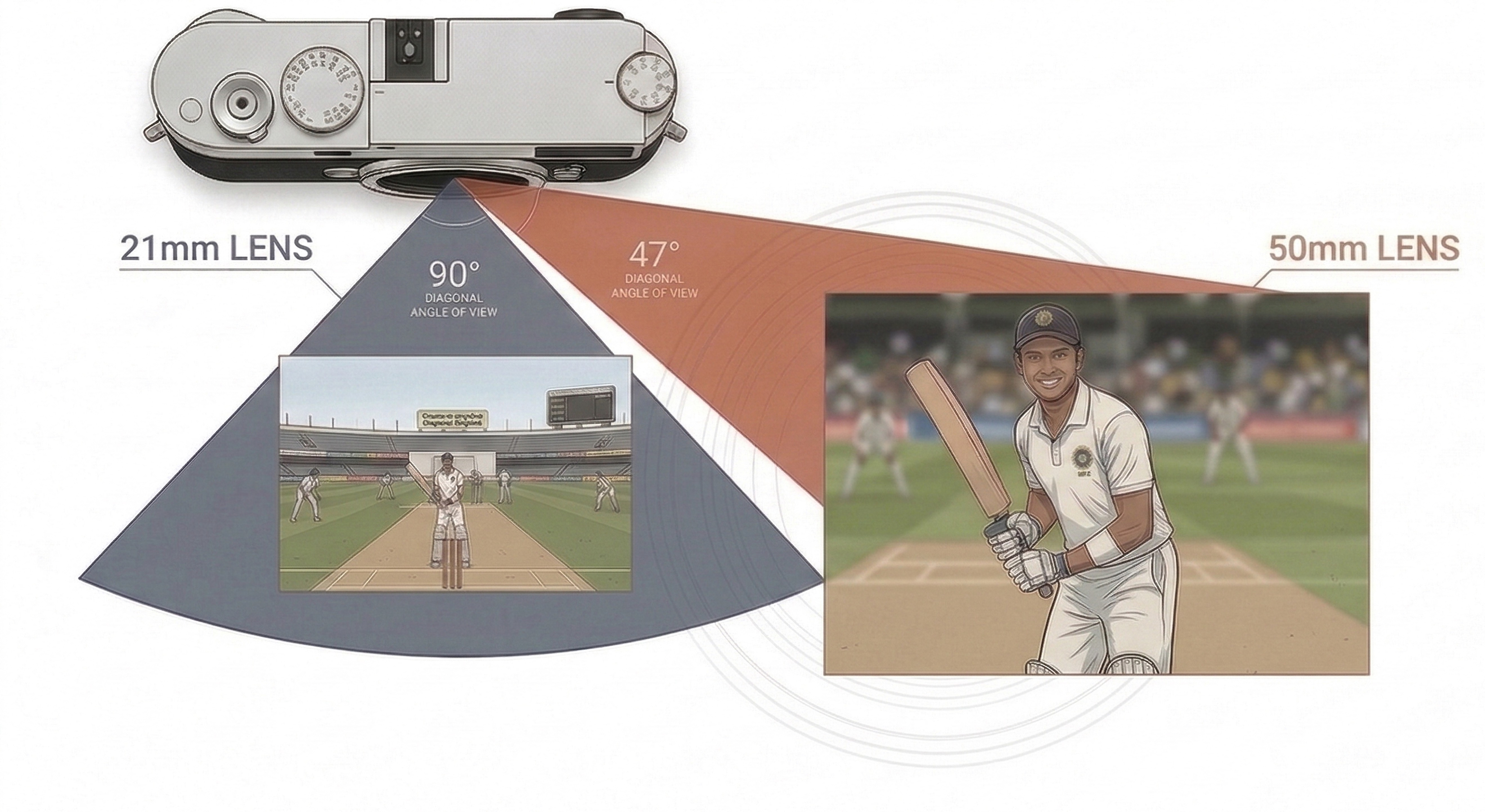
Most 50mm lenses have about a 47-degree angle of view on a full frame sensor. At this angle, the lens isn’t trying to overwhelm you with information like a 21mm, nor is it trying to isolate a single eyelash like a 90mm lens would. It sits in a thematic middle. It’s the visual equivalent of focused interest. Le Regard.
To better illustrate this, think about being on the pitch during warmups and scanning the field for a player you know. Your perspective darts around for something it recognizes. When it catches something that fits your search parameters—perhaps a facial feature or jersey number—it locks in. Your brain is effectively cropping out the rest of the world to match this angle of view.
If we adopted a wider lens, say a 35mm, we’d start to see the surrounding context again. Elements of the crowd begin to influence the scene, and the story becomes about the player and their environment.
If we go longer, to 75mm or 90mm, the background starts to compress and flatten, making the scene feel like it’s being observed from a distance. But at 50mm, the relationship between the subject and the background feels like the honest awareness we’d have in real life. There’s no wide angle distortion and no telephoto flattening.
So, When Does 50mm Shine?
When you understand the science, art, and philosophy that lay the groundwork for a 50mm lens, you have a significant advantage in deciding how to use it. This focal length doesn’t rely on optical wizardry to make an image interesting. Its strength comes from the honesty of the moment in front of you.
