

The True Power of the 21mm Perspective
Unpacking photography's most misunderstood focal length

The 21mm focal length has jumped in popularity over the last few years. With the release of several budget options, we’re seeing more people taking an interest in this perspective. However, no one seems to have a clear answer as to why you’d choose this perspective over another.
A quick search on YouTube and you’re hit with empty adjectives like cinematic, immersive, and epic. Reviewers are quick to praise this perspective for what it can do, but they offer about as much valuable context as instructions on a box of toothpicks.
Yes, this is a perspective that can look cool, but why is this focal length special? What makes it unique? And when should you use a lens like this? These are the questions I sought to answer after picking up a 21mm lens of my own.
I’ve spent the last eight months incorporating the Leica Summilux 21mm F1.4 into my work. I’ve put together a pretty robust review that’ll be published soon but this week, I want to clearly explain why a 21mm focal length is special, what makes it unique, and when you should choose this lens for your work.
Why 21mm? The Short Answer
The simple answer to why a 21mm focal length is special is because it houses a 90-degree angle of view that allows photographers to capture an incredibly wide perspective that still feels natural to humans. Because of the relationship between angle of view and distance, closing the gap between you and your subject can create frames that place your viewer directly in the scene. And it incorporates them into the experience without feeling artificial.
It’s the difference between watching an F1 car fly past on television and standing right by the fence as that V6 turbocharged hybrid engine screams by. One is observation. The other is this visceral assault on the senses. This is why 21mm is special.
Understanding the Angle of View
What gives the 21mm focal length its unique properties lies in the diagonal angle of view. The diagonal angle of view describes how much of a scene a lens can capture. Where focal length is a measure from the lens to the sensor, angle of view is the measure of the perspective landing from one corner of the sensor to the other. Quite simply, it’s the perspective being captured for any given lens relative to a sensor size.
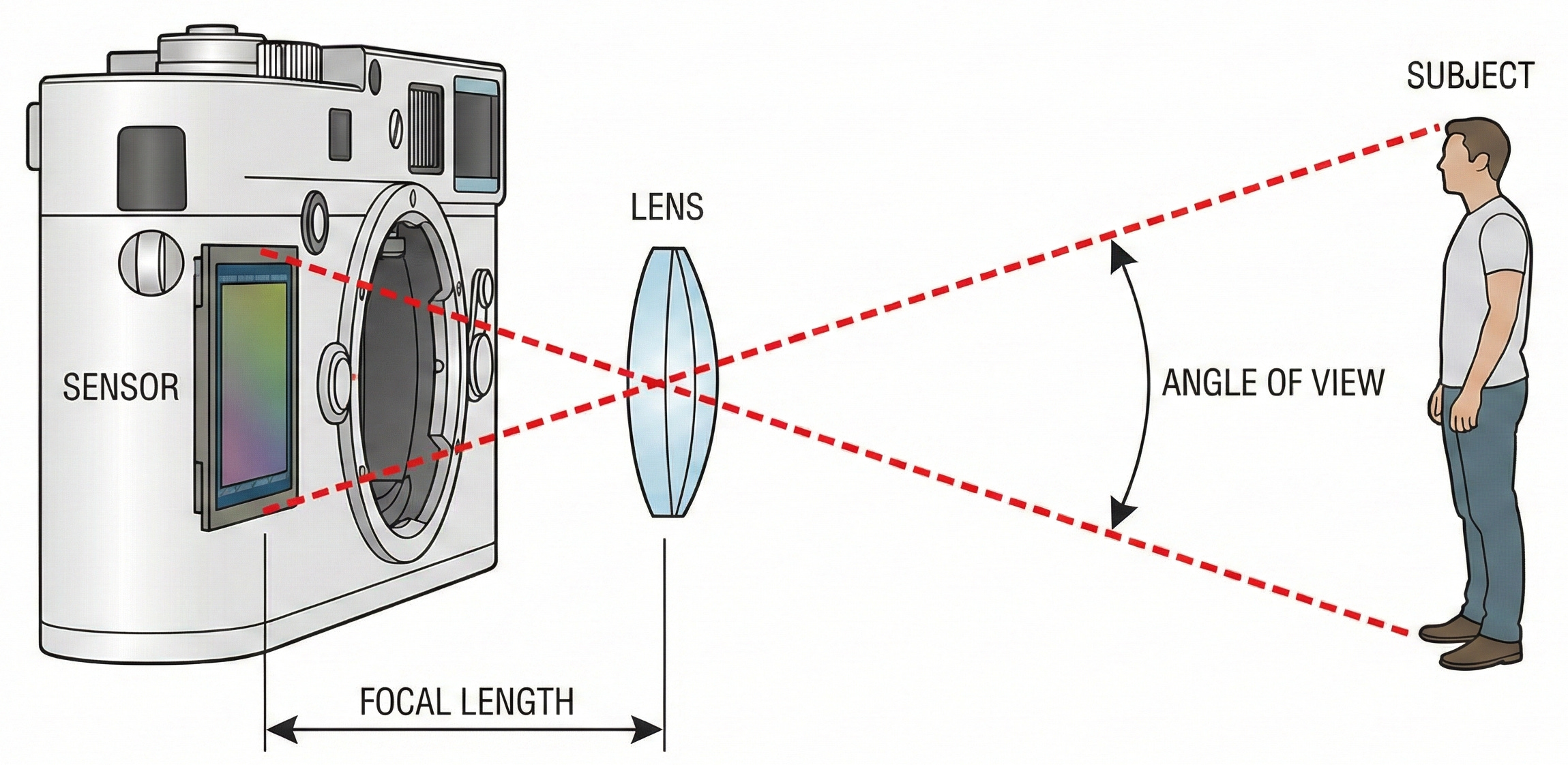
Using the diagram above as a reference, you can imagine that the longer the focal length you’re using, the smaller the angle of view. In other words, less of the world is being captured across the sensor. Conversely, the wider the lens you’re using, the wider the slice of the environment being captured. So, why is this important to understanding what makes 21mm so unique? Because it occupies a specific sweet spot.
Most lenses at a 21mm focal length will have roughly a 90-degree angle of view on a full-frame sensor. Anything beyond 90 degrees and you’re entering ultra-wide and fisheye territory. That’s a perspective that creates an image which feels beyond reality because it’s not how we experience the world. It’s the visual equivalent of looking at your reflection in the back of a spoon. A high angle of view is enveloping. It overwhelms us with information and creates a story that feels distorted. That’s not to say it’s bad, it’s just different. Knowing why it’s different helps us to know exactly when to choose this perspective.
Now, what if we get narrower than 90 degrees? Well, we capture less and less of the scene and we begin to capture thinner slices of an environment. The result is something that compresses what our eyes see and creates something that feels more intimate, perhaps even voyeuristic. A longer focal length and lower angle of view creates an image that hones our eyes onto the details. It’s like looking at the world through a cardboard tube. Importantly, it can still feel natural because we are used to locking in on details in the real world.

So, what happens when you use a lens that’s right around 90 degrees? We’re creating an opportunity to fool the viewer. At this perspective, we’re right at the barrier where things can still feel natural. A great 21mm lens, one that controls distortion well, creates a perspective that feels like seeing the world with wide-eyed optimism, as if you just landed in a brand new land. Because of how far it sits from focal lengths like the 28mm and 35mm, it distances itself from observation and creates a genuine feeling of being in the scene.
You don’t see the heat, you can feel it.
